
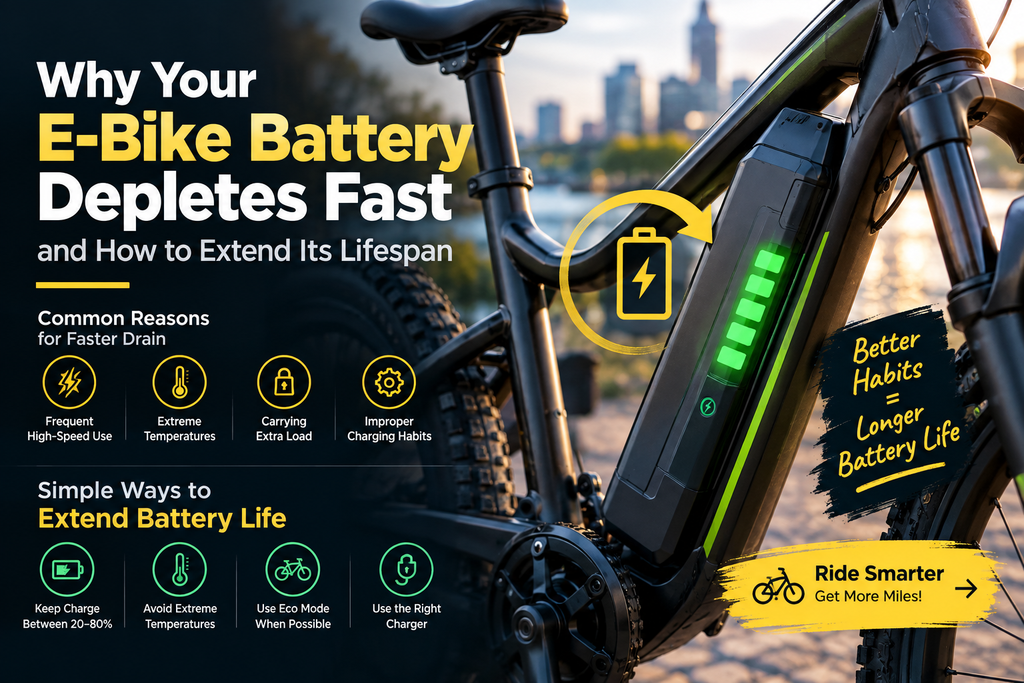
If your e-bike battery is draining fast, the problem is not always the battery itself. Riding habits, tyre pressure, assistance levels, weather and bike condition can all affect your range.
Understanding what is causing the extra battery drain can help you get more from every charge and protect your battery’s long-term performance. In this guide, we’ll explore the key causes of e-bike battery drain, ways to extend battery life and range, and when professional diagnostics may be needed.
Common Reasons Your E-Bike Battery Is Draining Fast
Wondering why your e-bike battery is draining fast? Several factors, including weather, riding conditions, terrain and mechanical resistance, can affect your battery’s performance and range. Let’s find out the key reasons.
1. Cold Weather Can Reduce Battery Range
Cold temperatures can affect the performance of lithium-ion batteries. When it’s a chilly winter morning in the UK, the temperature can drop enough that it reduces the effective range of the battery and you’re not getting the distance you’d expect on your electric bike. If your battery performs noticeably better again when temperatures rise, the cold weather may be contributing to the shorter range rather than indicating permanent battery failure.
2. High Assistance Levels Use More Energy
The UK sometimes experiences very hot weather and high temperatures have been known to impact the performance of lithium batteries of ebikes. They can also put undue strain on the battery during intensive or lengthy usage so it is important to be aware that hot weather can reduce the range of your e-bike.
3. Mechanical Resistance Makes the Motor Work Harder
Electric bike battery drainage can sometimes be related to the condition of the bike, rather than the battery itself. Under inflated tyres, dragging brakes or drive train resistance can all place additional loads on the motor, forcing it to consume more power to overcome. This additional effort increases energy consumption and can cause faster battery drain during everyday e-bike riding.
4. Repeated Deep Discharging Can Affect Battery Health
Deep discharging your lithium battery on a regular basis can cause damage to the cells and shorten its life cycle. As the battery loses capacity, it stores less energy on each charge, causing your e-bike battery to drain faster and provide fewer miles per charge.
5. Hills, Headwinds and Stop-Start Riding Use More Power
The route you take can have a huge impact on battery consumption. Hills require more assistance from the motor and headwinds increase resistance and repeated accelerations are needed. This can limit the range of your e-bike on UK roads, especially on arduous commuting routes
How to Maintain Your E-Bike Battery
Good e-bike battery maintenance is not complicated. A few consistent habits can help protect battery performance and make your electric bike more reliable over time.
1. Follow a Sensible Charging Routine
There isn’t one charging percentage that suits everyone/every battery as manufacturers will have their own guidelines. But it pays to avoid full discharges from the battery for regular use.
Keep in mind:
- The charging guidelines for your particular battery and charger.
- Use the correct manufacturer approved charger for the battery.
- Avoid fully discharging the battery on a regular basis.
- Unplug the charger when the battery is fully charged, don’t leave charging overnight or for extended periods of time.
- Charge batteries in a dry place, not in excessive heat.
When it comes to long term storage and regular charging, you should always follow the manufacturer’s guidelines, not general advice.
2. Take Extra Care of Your Battery in Winter
Cold weather can reduce the capacity of your e-bike battery and its ability to deliver power when you need it most.
In very cold weather:
- Store batteries in a dry indoor space if possible
- Allow discharged batteries to warm up to a reasonable temperature before recharging as per the manufacturer’s instructions
- Don’t charge cold batteries, or those subjected to freezing conditions
- Consider using a ‘cold weather’ battery cover if your manufacturer recommends them and you live in a cold climate
- Avoid leaving batteries in direct sunlight or other hot environments
Bosch for example, recommends charging and storing their batteries at room temperature and that they be stored at the correct temperature for long term storage.
3. Store the Battery Correctly
Going on holiday or just not using your bike for several weeks? Storing your battery correctly is just as important as the first two tips.
For long term storage:
- The storage charge for your battery should be in line with the manufacturers guidelines. (Bosch for example, recommends 30-60% for long term storage.)
- Store your battery in a dry place, away from extremes of heat/cold.
- Avoid direct sunlight and unnecessary moisture
- Avoid leaving the battery flat/discharged for any length of time.
Other manufacturers may have different requirements so check with your battery manufacturer if you’re not sure.
__________________________________
How to Get More Range From Your E-Bike
Battery capacity is only one factor that determines your actual range on an e-bike. The way you ride can also significantly impact the rate at which your battery charge is lost and how many miles you get from a single charge.
Use the Gears properly
Don’t always rely on the motor when going up hills or accelerating from a standstill. Make sure to put a gear that is right for you and keep the pedals spinning at a comfortable rate. Using the right gears in conjunction with the motor can make climbing much easier and also provide you with more miles from each charge on your e-bike.
Choose the Right Assistance Mode
You don’t always need to have the highest assistance power when riding your e-bike. A lower grade assistance can be used on flat stretches of road while a higher grade can be reserved for climbing or when you actually need the help. Choosing the appropriate electric bike power mode can help control energy consumption and extend your battery range.
Keep the Tyres at the Recommended Pressure
Tyre pressure has a direct effect on rolling resistance and can influence your overall e-bike efficiency. Make sure that you keep the correct pressure as recommended for the tyres on your bike. Don’t just go for the highest pressure available as this can put unnecessary strain on your e-bike’s wheels and other components. The recommended pressure will vary depending on the type of tyre, your bike and the conditions you are riding in.
Ride Smoothly
Constant rapid acceleration and riding at unnecessarily high speeds is not going to provide you with the best range on your e-bike. Slower, more sedate riding while anticipating junctions and other hazards can help you to manage the battery capacity of your e-bike and get more miles from each charge, especially when riding your e-bike around the UK and commuting on a regular basis.
Consider the Conditions
Your e-bike isn’t going to provide you with the same range on every journey. Hills, winds, cold weather, your own weight and any luggage you are carrying plus the pressure of your tyres and the assistance grade you are using can all impact on how much power your e-bike uses. So, a shorter range on your e-bike on a cold, windy and hilly day doesn’t always mean that there is something wrong with your battery.
When Should You Get Your E-Bike Battery Checked?
Some changes in battery performance are normal as a battery ages. Others should not be ignored.
Consider professional e-bike battery diagnostics if you notice:
- The battery percentage is depleting unusually fast.
- E-bike deliver significantly reduced range than average for the same conditions.
- The bike shuts down unexpectedly.
- There is a continuous display of an electrical/system fault.
- The battery case is swollen, cracked or otherwise damaged.
- There are unusual odors, heat or other irregularities from the battery.
Never attempt to open or repair a lithium-ion battery yourself. A damaged battery can have internal issues which are not apparent, and should be professionally diagnosed.
Professional E-Bike Battery Diagnostics and Servicing in Woking
If you are having an issue with a flat ebike battery in Woking, our Woking Bikes team can help investigate whether the issue is with the battery, electrical system or elsewhere on the bike.
Rather than jumping straight to buying a replacement, our technicians can carry out a comprehensive inspection looking for potential issues.
- Battery and Electrical Diagnostics : We can examine the electrical system and investigate issues affecting the battery performance, charging or power delivery.
- Bosch System Diagnostics: As a Bosch partner workshop we can use the relevant diagnostic tools for the Bosch e-bike system to help detect system faults and check relevant battery information.
- Battery Fault Investigation: If you are having an issue with your e-bike battery dying quickly, we can investigate the charging system and relevant electrical components looking for the source of the issue.
- Motor and Electrical Checks: Performance of the battery can also be affected by issues elsewhere on the e-bike. We can check the relevant electrical connections and mechanical components looking for resistance or issues that could be impacting the power delivery.
Frequently Asked Questions
Why is my e-bike battery draining so quickly?
Common causes include high assistance levels, cold weather, low tyre pressure, hills, strong winds, mechanical resistance and normal battery ageing.
How can I make my e-bike battery last longer?
Use the correct charger, avoid repeated deep discharges, store the battery correctly, maintain your tyres and use assistance levels appropriate for your route.
Does cold weather affect e-bike battery range?
Yes. Cold temperatures can temporarily reduce battery performance and available range. Keeping the battery at a suitable temperature and following the manufacturer’s winter-care guidance can help.
Can I charge my e-bike battery overnight?
It is better to follow the manufacturer’s charging instructions and avoid leaving a battery charging unattended or connected indefinitely. Once charging is complete, unplug it where practical.
How long does an e-bike battery take to charge?
Charging time varies by battery capacity, charger and manufacturer. Many e-bike batteries take several hours to charge fully, so check the specifications for your particular system.
How should I store an e-bike battery when I am not using my bike?
Keep it in a dry place away from extreme temperatures and direct sunlight, and follow the manufacturer’s recommended storage charge level. Bosch, for example, recommends around 30–60% for longer-term storage.
Can an e-bike battery be repaired?
A damaged lithium-ion battery should not be opened or repaired as a DIY job. If it has physical damage, swelling or another serious fault, stop using it and have it assessed by a qualified professional.
Why does my e-bike lose range even when the battery is fully charged?
A full battery does not guarantee the same range on every journey. Weather, terrain, wind, rider load, tyre pressure, riding speed and assistance level can all affect actual range.
Keep Your E-Bike Performing at Its Best
A rapidly draining battery does not always mean you need a new one. The right charging routine, regular maintenance and efficient riding habits can all help protect your e-bike battery life and range.
If your e-bike is still losing power unusually quickly, our expert technicians at Woking Bikes can help diagnose the problem and recommend the right next step. Contact us today to arrange professional e-bike servicing and diagnostics in Woking.
CONTACT WOKING BIKES
Address:
12 The Broadway, Woking GU21 5AP, United Kingdom
Map: View on Google Maps
Phone: +44 1483 363063
Website: www.wokingbikes.co.uk
Opening Hours: Monday–Saturday, 10:00 AM – 6:00 PM
Let Woking Bikes keep you moving.